


.avif)


Agriculture is one of the fastest-growing verticals for IoT solution providers. Growers and agribusiness operators across North America, Latin America, Europe and Asia-Pacific are investing in connected systems to manage equipment, water, soil and livestock more efficiently. For solution providers building in this space, the demand is real, but so are the connectivity challenges. This article covers the market drivers, dominant use cases and regional differences that shape buyer priorities and what the most successful agriculture IoT deployments have in common.
Key takeaways
- IoT adoption in agriculture continues to accelerate as growers seek better visibility into equipment, irrigation systems, livestock and environmental conditions.
- Solution providers are building connected agriculture systems across North America, Latin America, Europe and Asia-Pacific to improve operational efficiency, reduce resource waste and support data-driven decision-making.
- Reliable connectivity remains one of the biggest barriers to deployment. Much of the world’s agricultural infrastructure operates beyond dependable cellular coverage, making satellite and hybrid satellite-cellular connectivity essential for large-scale remote monitoring and control.
Why is agriculture IoT growing faster than most sectors?
The global smart agriculture market is expanding quickly. Precision farming, real-time monitoring and data-driven decision-making are moving from early adopter territory into standard practice across major growing regions.
Farmers are under pressure from multiple directions at once—input costs, water regulations, labor shortages and climate variability. Each of those pressures has a corresponding IoT application. For solution providers, that convergence creates a durable market, not a trend.
A few figures frame the opportunity:
- The global smart agriculture market is projected to reach $31.2 billion by 2028, growing at roughly 15.5% annually
- Farms using connected monitoring systems have reported yield improvements and input cost reductions of 20% to 40%
- Water management is the largest single application category, driven by regulation and scarcity
For solution providers, these trends represent a long-term market opportunity rather than a temporary technology cycle.
What agriculture buyers are looking for?
Before building anything, it helps to understand what growers and agribusiness operators are asking for. Across the regions with the highest IoT adoption, the most common buyer priorities break down into four categories.
Farm equipment tracking
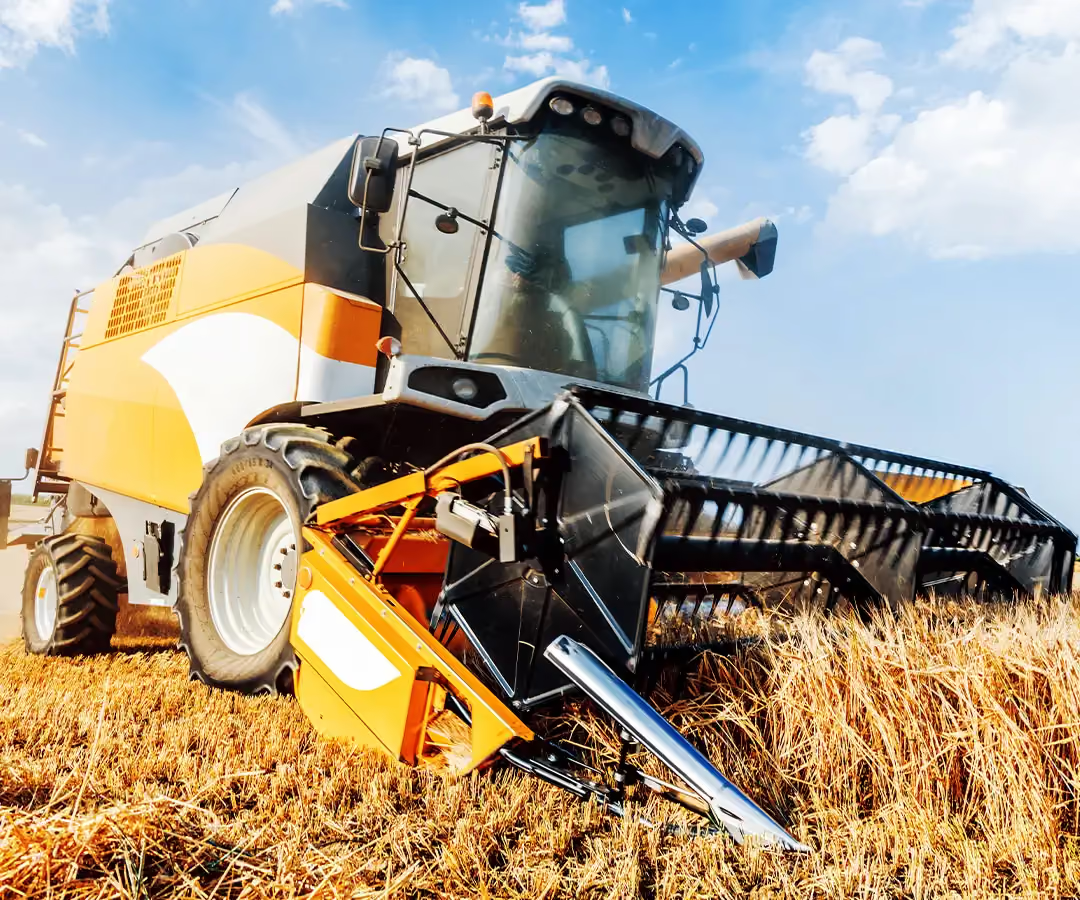
Farm equipment tracking is the most immediate ROI driver for most growers. Knowing where a harvester, tractor or utility vehicle is at any moment and whether it’s running efficiently directly affects productivity and fuel costs.
For solution providers, this is often the entry point into a larger IoT relationship. A customer that starts with farm equipment GPS tracking often expands into soil monitoring, irrigation control and weather data over time.
Remote soil moisture monitoring
Remote soil moisture monitoring has become one of the most widely adopted precision agriculture applications. Industry forecasts project the global soil monitoring market will grow from approximately $375 million in 2022 to more than $1 billion by 2030, reflecting increasing demand for data-driven irrigation management and resource optimization.
The challenge is that most soil sensors are deployed far from cellular towers. Satellite connectivity is what makes remote soil moisture sensing viable at scale, across large farms where running cable or installing gateways is impractical.
Precision irrigation monitoring without cellular
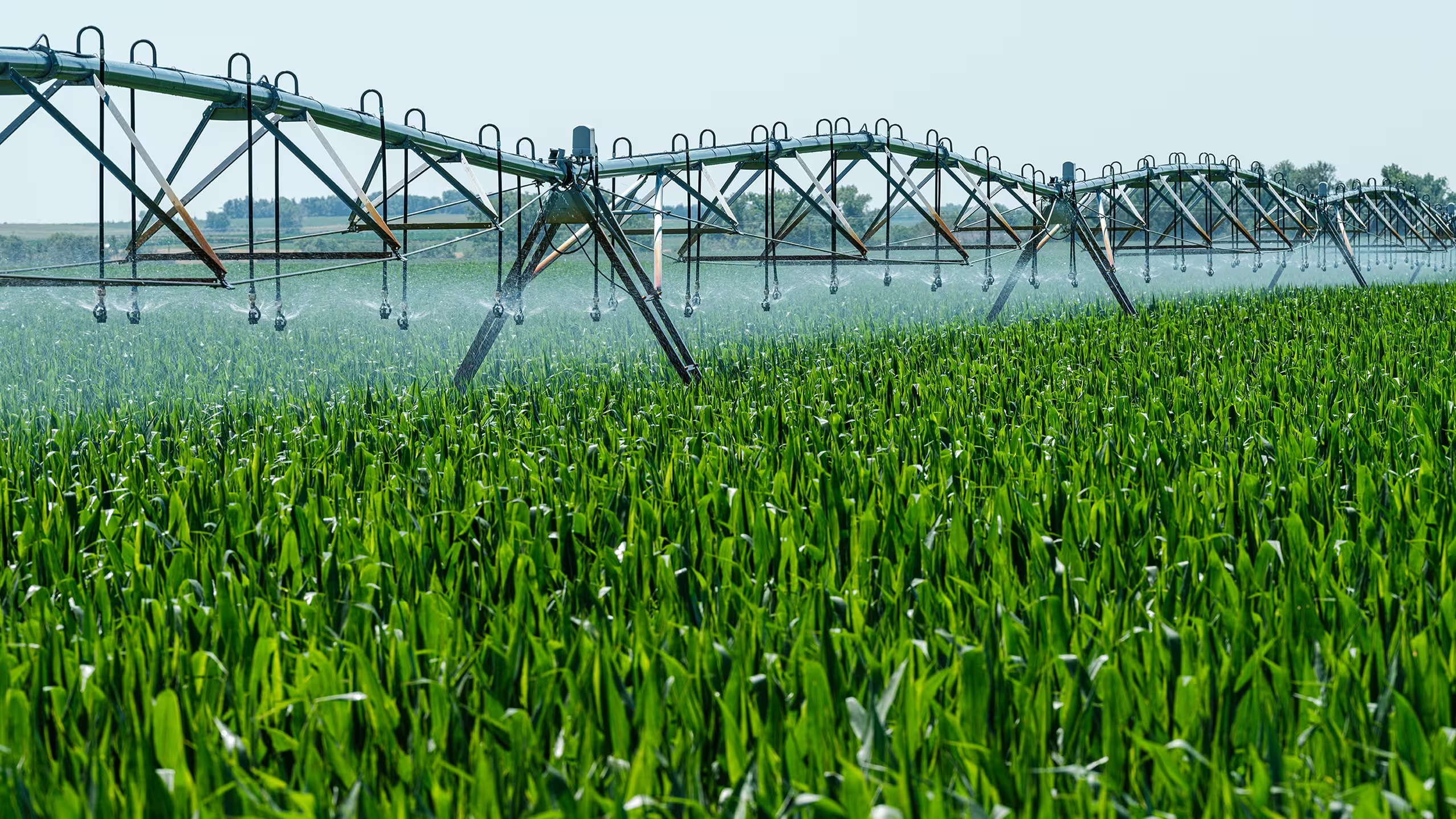
Precision irrigation monitoring without cellular is one of the fastest-growing use cases, particularly in Latin America and parts of Southeast Asia where farms are large and cellular infrastructure is thin.
Ponce, a SKYWAVE partner based in Argentina, built an irrigation monitoring system on SKYWAVE satellite technology that helps farmers across the region reduce water waste and protect yields.
“We work with many farmers in remote regions that are unable to obtain cellular coverage for equipment monitoring. SKYWAVE’s satellite network enables us to provide global coverage.” — Jose Robetto, CEO, Ponce
One of Ponce’s customers, La Guía, monitors over 2,000 hectares with 19 irrigation machines. Before the system was in place, inspectors drove over 40 kilometers per site visit. With precision irrigation monitoring in place, the entire team gets notified the moment a machine fails, directly on their phones.
Smart irrigation scheduling for large farms is the logical next step once continuous soil and equipment data is available—automated watering decisions based on real field conditions rather than fixed timetables, reducing both water use and manual intervention.
Tracking cattle in areas without 4G
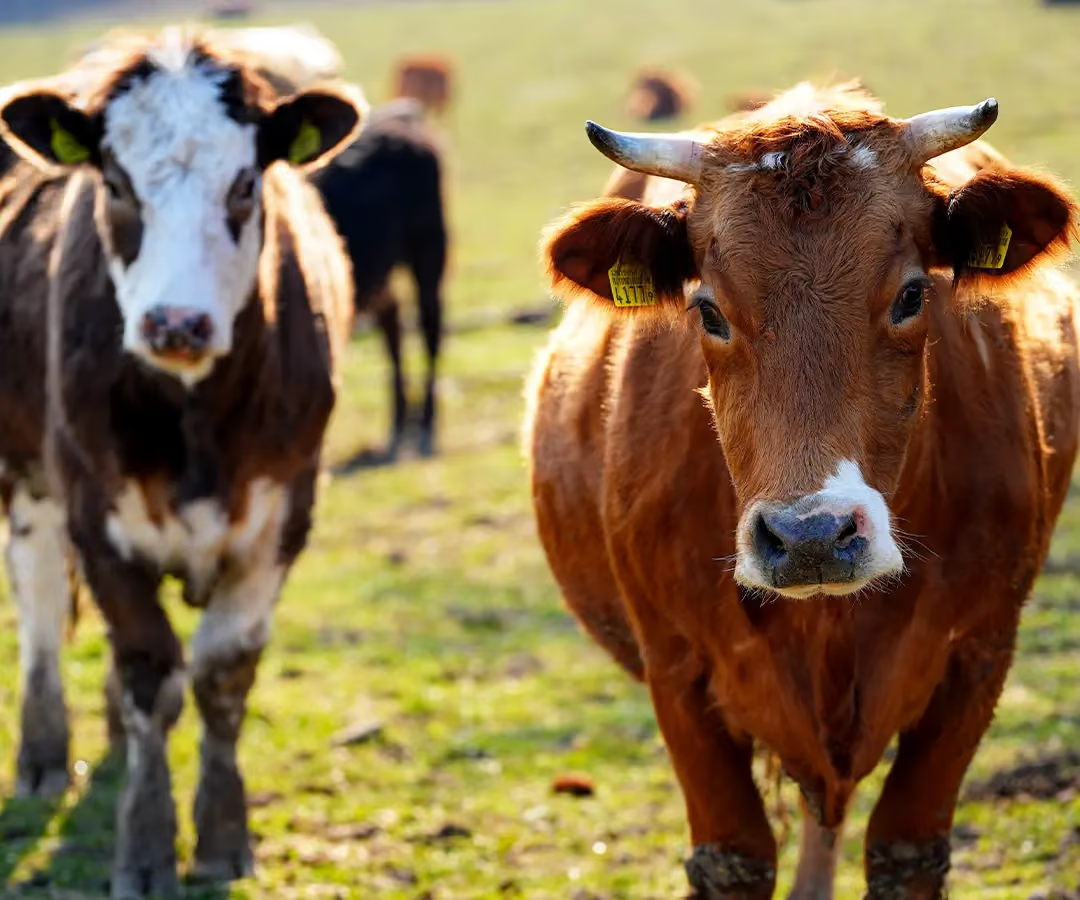
Tracking cattle in areas without 4G is a significant and underserved use case across North America, Australia and parts of South America. Ranches span hundreds of thousands of acres, most of it well beyond reliable cellular range.
Satellite-connected monitoring solutions help ranchers maintain visibility across remote operations without requiring frequent site visits.
Regional drivers of agricultural IoT adoption
Agriculture IoT adoption in agriculture is not uniform. Different regions are driven by different market pressures.
North America: Scale, labor shortages and operational efficiency
North America accounts for approximately 32% of the global agriculture IoT solutions market, supported by large-scale farming operations, advanced mechanization and strong technology adoption. Labor shortages, rising operating costs and pressure to improve productivity continue to drive investment in farm equipment tracking, remote monitoring and automated irrigation systems.
Latin America: Water scarcity and export-grade quality requirements
Water scarcity and export-grade quality requirements are the primary drivers. Precision irrigation monitoring without cellular is the dominant use case given the large farm footprints and inconsistent cellular coverage across Argentina, Brazil and Chile. SKYWAVE partners like Ponce and Wiagro are active in this region.
Europe: Regulatory compliance and sustainability reporting
Regulatory compliance and sustainability reporting requirements are driving adoption. EU farm-to-fork regulations create a reporting layer that requires data collection at the field level. Microclimate monitoring for planting and harvesting is a growing application, particularly in wine, specialty crop and horticultural operations.
Asia-Pacific: Rapid adoption driven by large-scale operations and connectivity investment
Smallholder and cooperative farming dominate in parts of Southeast Asia, but large-scale rice, palm and rubber operations are adopting IoT rapidly. Connectivity gaps are the biggest constraint, making satellite the default network for remote deployments.
Satellite vs. cellular: Which connectivity is right for agriculture IoT?
Most IoT adoption articles focus on sensors, platforms and analytics. The piece that gets less attention is connectivity—specifically, what happens when a field, ranch or pump station sits beyond reliable cellular coverage.
Cellular-only IoT deployments have a hard geographic boundary. Remote assets outside cellular coverage can’t reliably transmit operational data, limiting visibility and delaying operational decisions.
For solution providers, satellite connectivity turns a cellular-limited product into one that works anywhere a customer farms. With hybrid connectivity, you get the economics of cellular where it exists and the reliability of satellite where it doesn’t—in a single device, without managing two separate hardware configurations.
What solution providers are building on satellite
The most successful agriculture IoT deployments we see share a few common characteristics:
They solve a specific operational problem.
The best solutions don’t try to do everything. They start with one measurable outcome—reduce fuel use, cut irrigation waste or improve water management and expand from there.
They’re designed for the connectivity environment, not against it.
Building a solution that assumes cellular coverage is always available limits its applicability to only a small fraction of farmland. A satellite-first approach ensures the solution works everywhere.
They combine live data with actionable outputs.
The value of connected agriculture comes from timely decision-making.Effective solutions provide alerts, recommendations and operational context, not just raw data.
They integrate with what farmers already use.
Farm management software, accounting tools and equipment telemetry are already in place on most large operations. The best IoT additions connect to what’s there rather than asking farmers to adopt a new platform from scratch.
Build agriculture IoT platforms for assets outside cellular range
Talk to a SKYWAVE specialist about connectivity options for your device, data and deployment requirements.
FAQ
What is farm equipment tracking?
Farm equipment tracking uses GPS and IoT sensors to monitor the real-time location, utilization and performance of tractors, harvesters, trucks and other agricultural machinery. A solution provider’s platform can present this data so customers can improve scheduling, identify unnecessary idling and respond to operating issues sooner.
How does remote soil moisture monitoring work?
Remote soil moisture monitoring uses in-ground sensors to measure water content at the root level. Cellular or satellite connectivity carries the readings to a solution provider’s platform, where growers and irrigation operators can use the data to inform watering schedules.
Why is satellite connectivity important for agriculture IoT?
Most farmland sits beyond reliable cellular coverage. Satellite connectivity can carry data from those assets to a solution provider’s platform, which can support remote monitoring, alerts and control workflows.
What is precision irrigation monitoring without cellular?
Precision irrigation monitoring uses soil, weather and equipment data to inform irrigation decisions. When infrastructure operates outside cellular range, satellite connectivity can transmit that data to a solution provider’s platform. The platform can then support alerts, irrigation schedules or configured automation.
How does microclimate monitoring help farmers?
Microclimate monitoring uses field-level sensors to track temperature, humidity, wind and rainfall at a granular level rather than relying on regional weather data. This supports more accurate timing for planting, spraying, harvesting and frost protection.
.avif)
.avif)
%201.svg)